
What Are the Best Wi-Fi HaLow Devices in 2026?
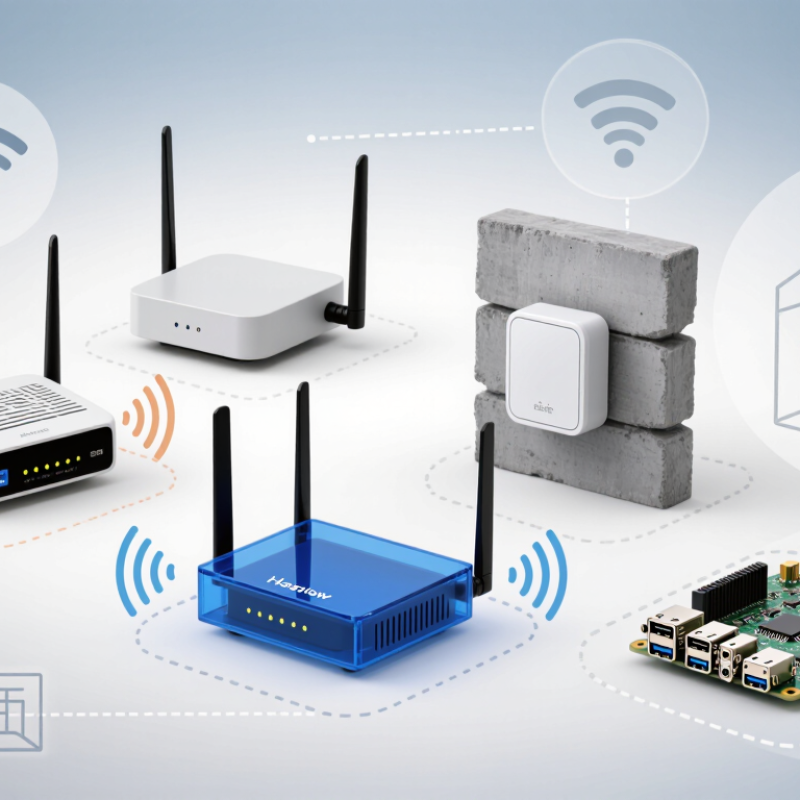
Choosing the best Wi-Fi HaLow devices in 2026 means looking beyond headline range. A sensor mounted behind a concrete wall faces a different task from a camera beside a router. Wi-Fi HaLow uses sub-gigahertz frequencies and is designed for longer-range, lower-power connections than conventional Wi-Fi. But actual results depend on antennas, obstacles, local radio conditions, and device settings. Walls matter.
Cees Links, a veteran Wi-Fi industry executive, has highlighted Wi-Fi HaLow’s potential to bring familiar Wi-Fi networking to long-range, low-power IoT devices. That promise is useful, but it is not a guarantee of performance in every home or building. A product’s supported bands, security features, power requirements, and compatibility with your access point deserve close attention. So does the manufacturer’s documentation. Some product pages make range sound effortless. Real installations are less tidy.
This guide compares the strongest device options for different needs, including access points, development boards, sensors, and gateways. It looks at setup demands, ecosystem support, practical coverage, and the trade-offs between ready-to-use hardware and hands-on projects. A development board may offer flexibility but require extra configuration. A finished device can be simpler, yet harder to adapt. That is not trivial. The best choice is the one that fits your deployment—not simply the one with the biggest advertised range.
Wi-Fi HaLow in 2026: 802.11ah, Sub-1 GHz Bands, and Key Features
Wi-Fi HaLow is the 802.11ah Wi-Fi standard, designed for sub-1 GHz operation. Unlike crowded 2.4 GHz links, its lower-frequency signals can travel farther and pass through walls more effectively, though building materials still matter. The Wi-Fi Alliance’s Wi-Fi CERTIFIED HaLow technical overview reports coverage beyond 1 km and support for thousands of devices per access point. Treat these as best-case capabilities, not a guarantee for every site. Actual performance depends on antennas, interference, and regional spectrum rules.
IEEE 802.11ah supports channel widths from 1 to 16 MHz. Narrow channels can help conserve airtime in sensor networks, while wider channels allow higher throughput. This makes HaLow a practical fit for meters, farm sensors, and warehouse monitors that send small updates over long distances. It is not a substitute for high-capacity video links. Compatibility also deserves a careful check: a device may use HaLow yet lack the sleep behavior or management features your deployment needs.
Tips: Check the supported local band, standby power, wake-up time, and firmware-update policy before choosing hardware. Test through real walls. A hallway test can mislead. Measure packet delivery at the farthest sensor, then repeat during busy hours. One overlooked detail is maintenance: long battery life means little if a device becomes difficult to update.
What Are the Best Wi-Fi HaLow Devices in 2026? — Wi-Fi HaLow in 2026: 802.11ah, Sub-1 GHz Bands, and Key Features
This comparison covers device types rather than specific brands. The best choice depends on coverage, power, throughput, and whether the device must connect to an existing IP network.
| Device type | Best suited for | Typical role | Key Wi-Fi HaLow characteristics | What to check before choosing |
|---|---|---|---|---|
| Outdoor HaLow access point or gateway | Wide-area sensor networks, farms, campuses, and outdoor infrastructure | Provides a HaLow link for endpoint devices and typically connects onward to an IP network. | Uses region-approved sub-1 GHz channels. Lower-frequency operation can improve propagation and obstacle penetration compared with 2.4 GHz Wi-Fi, but actual coverage depends on terrain, antennas, power limits, and installation. | Regional radio certification, supported channel plan, outdoor enclosure rating, antenna options, Ethernet or backhaul method, and the number of supported stations. |
| Indoor HaLow access point | Buildings with many low-power devices or coverage needs beyond a conventional local Wi-Fi cell | Acts as the wireless access point for HaLow sensors and other compatible clients. | IEEE 802.11ah operates in sub-1 GHz spectrum; supported frequencies vary by country. HaLow networks use narrower channel options than conventional high-throughput Wi-Fi deployments. | Compatibility with the intended client devices, local band and channel support, network-management features, and the wired or wireless uplink. |
| HaLow-to-Ethernet bridge | Connecting wired equipment in remote or hard-to-cable locations | Passes network traffic between a HaLow wireless link and an Ethernet port. | Can extend an IP network without requiring the attached Ethernet equipment itself to include a HaLow radio. | Bridge versus router operating mode, Ethernet speed, power requirements, supported security configuration, and whether the device supports the required network topology. |
| Embedded HaLow module or development board | Prototyping and integrating HaLow connectivity into custom products | Adds a HaLow radio to a host board or embedded system through a supported interface. | Useful for application-specific devices; radio performance and available features depend on the module, antenna design, firmware, and host integration. | Host interface, software and driver support, antenna and RF layout requirements, power use, certification status, and availability of documentation. |
| Battery-powered HaLow sensor node | Environmental, agricultural, utility, and building-monitoring sensors | Collects measurements and sends them to a HaLow access point or gateway. | Designed for low-power, long-range networking; battery life is not guaranteed by the standard and depends on sleep behavior, reporting frequency, signal conditions, and implementation. | Measured battery life under a stated reporting interval, sleep and wake support, sensor interfaces, enclosure rating, and compatibility with the target access point. |
| HaLow camera or image endpoint | Remote monitoring where ordinary Wi-Fi coverage is insufficient | Sends images or video over a HaLow link when the application’s required data rate is supported. | HaLow can support higher data rates with wider channels and suitable radio configurations, but available throughput varies by channel width, signal quality, and regional rules. | Required resolution and frame rate, sustained application throughput, channel width, antenna placement, and tested performance at the intended distance. |
Selection note: Wi-Fi HaLow is based on IEEE 802.11ah and uses sub-1 GHz spectrum, with permitted bands and channel availability varying by region. The standard defines multiple channel widths, but a particular device may support only a subset. No single range or battery-life figure applies to all HaLow devices.