Why Choose Organic Spirulina for Your Business?
Organic Spirulina is moving from niche ingredient to a considered business choice. Buyers want plant-based color, recognizable sourcing, and dependable quality. Yet “organic” alone does not prove a product’s nutritional value or consistency. That distinction matters.
The FAO’s 2024 State of World Fisheries and Aquaculture reports 37.8 million tonnes of global algae production in 2022, mostly seaweeds—not spirulina. The figure signals a large algae sector, but it should not be presented as spirulina-market size. Ripley D. Fox, author of Spirulina: Production & Potential, captured the promise with the phrase “food for the future.” Promise, however, is not a purchasing specification.
For a business, the stronger case rests on evidence customers can check. Ask suppliers for current organic certification, batch-specific certificates of analysis, traceability records, and testing for relevant contaminants. Check cultivation and drying methods, too. A vivid green powder can look reassuring in a sample jar, yet color alone says little about its quality. Standards and certification scope also vary by market, so verify the documents that apply to your customers.
Start with a small, documented trial. Compare taste, color, solubility, and batch consistency before committing to a large order. Organic Spirulina can support a credible product story, but only when sourcing claims are transparent and verifiable. The category still has gaps in comparable public data. That deserves a little humility.
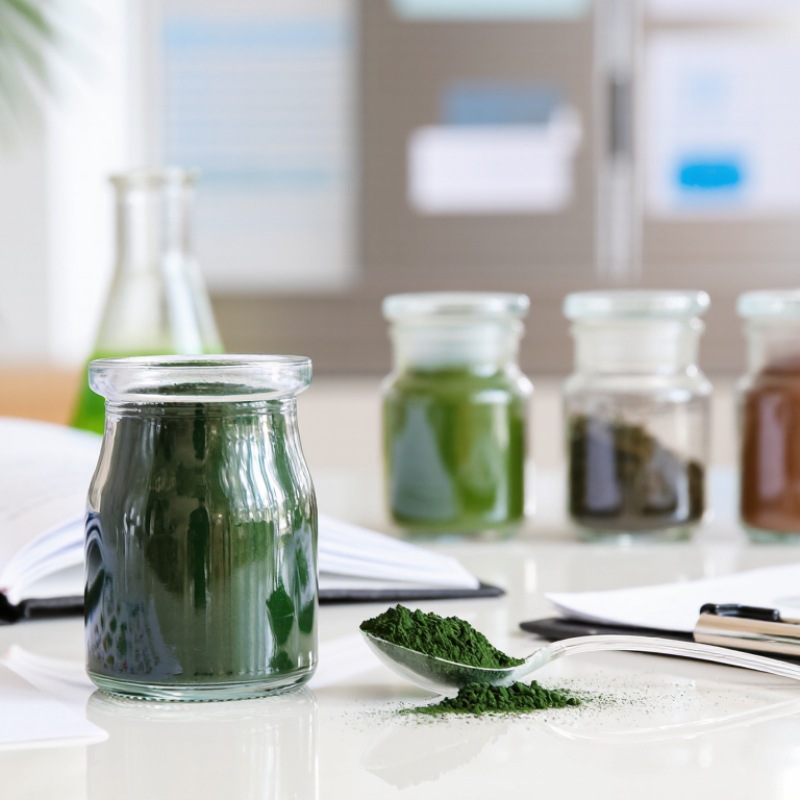
What Organic Spirulina Is: A Cyanobacterium Sold as Food Biomass
Organic spirulina is the dried food biomass of photosynthetic cyanobacteria, commonly identified as Arthrospira species. It grows in controlled water systems and is harvested, dried, and milled into powder or pressed into tablets. Not seaweed. Its blue-green color comes partly from natural pigments, including phycocyanin. The FAO’s 2008 technical review of spirulina culture and production describes its use as food biomass, rather than a purified extract.
For a nutritional reference, the USDA FoodData Central entry for dried spirulina lists about 57.5 grams of protein per 100 grams. That figure describes a database sample, not a guarantee for every batch; growing and processing conditions can affect composition. It can be tempting to treat a strong number as a promise. It isn’t. Buyers should assess the finished ingredient, its intended use, and supplier documentation together.
Tips: Request organic certification and a recent certificate of analysis. Check batch identity, protein data, and testing for microbial and chemical contaminants. Organic status describes production standards; it does not, by itself, prove higher nutrition or consistent quality. Keep it simple: verify the paperwork against the specific lot you plan to buy.
Nutrient Profile: USDA Data Report 57.5 g Protein per 100 g Dried Spirulina
Why Choose Organic Spirulina for Your Business?
For product developers, dried spirulina offers a concentrated protein figure: USDA FoodData Central reports 57.5 grams per 100 grams. That is a meaningful benchmark for comparing ingredient specifications. But 100 grams is not a typical serving. A 5-gram portion provides roughly 2.9 grams of protein, before accounting for variation between batches. Small scoop. Real context.
The FAO’s 2008 review of spirulina production and use describes dried spirulina as a protein-rich food, while noting that composition can vary with cultivation and processing. This helps explain why supplier data and independent testing matter. Protein percentage alone does not establish amino-acid balance, digestibility, or performance in a finished recipe. The headline number is useful, but not the whole story. A strong green hue and marine, earthy aroma can also affect consumer acceptance, especially in drinks and snack formulations. Organic sourcing may support a business’s ingredient-positioning goals, yet certification and nutrient claims should be checked against the relevant supplier documents and applicable standards. For procurement teams, request a current certificate of analysis, confirm the test method, and compare protein on a dry-weight basis. One caution: figures from a general database describe a reference food, not every lot on the market.
Organic Label Rules: USDA Requires 95% Organic Ingredients for “Organic” Claims
For a business sourcing organic spirulina, the label starts with the finished product—not a supplier’s brochure. Under USDA rules, a product labeled “organic” generally must contain at least 95% certified organic ingredients by weight, excluding water and salt. The remaining ingredients must meet applicable National Organic Program requirements. The product and its handling chain may also require certification. A green powder can seem simple, but blends, carriers, and flavorings can change the calculation.
That threshold matters when formulating capsules, drink mixes, or snack powders. Keep current organic certificates, ingredient specifications, invoices, and batch records. Check that documents cover the exact material and handling steps. Ask a qualified certifier to review the formula and proposed label before printing packaging. “Made with organic” follows a different standard, generally requiring at least 70% organic ingredients, and does not allow use of the USDA Organic seal. Details can vary by product, so avoid guessing.
Tips: Keep a percentage worksheet for each formula. Update it when suppliers or ingredient ratios change. Check label artwork against the certifier’s approved version. Small details matter. A supplier’s organic status alone may not cover your finished product; that assumption deserves a second look.
Business Applications: Match Certified Spirulina to Food, Supplement, and Feed Uses
Organic spirulina can serve different business needs, but one certificate does not make every product suitable for every use. For food, check that the certification covers the intended ingredient and processing site. Then review color, flavor, moisture, and microbiological results against your product specification. A small test batch can reveal a practical issue: a vivid green powder may still taste too strong in a mild beverage.
For supplements, request batch-specific identity and contaminant test results, plus documentation showing traceability from harvest through packing. Confirm that the powder’s nutrient data comes from a defined testing method; values can vary with growing and processing conditions. Paperwork matters. So does a sample.
Feed applications need a different review. Match the ingredient’s composition and inclusion rate to the target species, feed formulation, and local requirements. Ask suppliers for relevant safety data and handling guidance, rather than assuming food-grade documentation answers every feed question. Storage deserves attention too: keep sacks sealed, dry, and away from direct light, and check whether packaging protects the powder during transport.
The best choice is the certified material whose scope, test records, and physical properties fit the actual application. Teams sometimes focus on certification and overlook how a batch behaves in production. That is worth reconsidering before a large order.
Sourcing Checks: Verify COAs, Contaminant Tests, Traceability, and Batch Specs
Why Choose Organic Spirulina for Your Business?
Organic spirulina can support a clear sourcing story, but an organic claim does not confirm product quality by itself. Ask for a current, batch-specific certificate of analysis (COA). Check the lot number, test date, methods, and actual results—not only pass statements. Review relevant tests for heavy metals, microcystins, and microbial contaminants. A neat certificate is not proof on its own.
Tips: Match the COA lot number to the shipment. Confirm the testing laboratory and ask what each specification means. Check traceability records from cultivation through drying and packing. Batch specs should state measurable details, such as moisture, protein, and phycocyanin content, with clear units and acceptance ranges. Keep the documents together with receiving records.
Even careful checks can leave gaps. A supplier may provide detailed paperwork, yet the records may not explain a change in color or odor between batches. Ask how deviations are investigated and whether retained samples are available. Compare recent batch results, rather than relying on one attractive sample. I would not treat “organic” as a shortcut; consistent documentation and follow-up matter just as much.